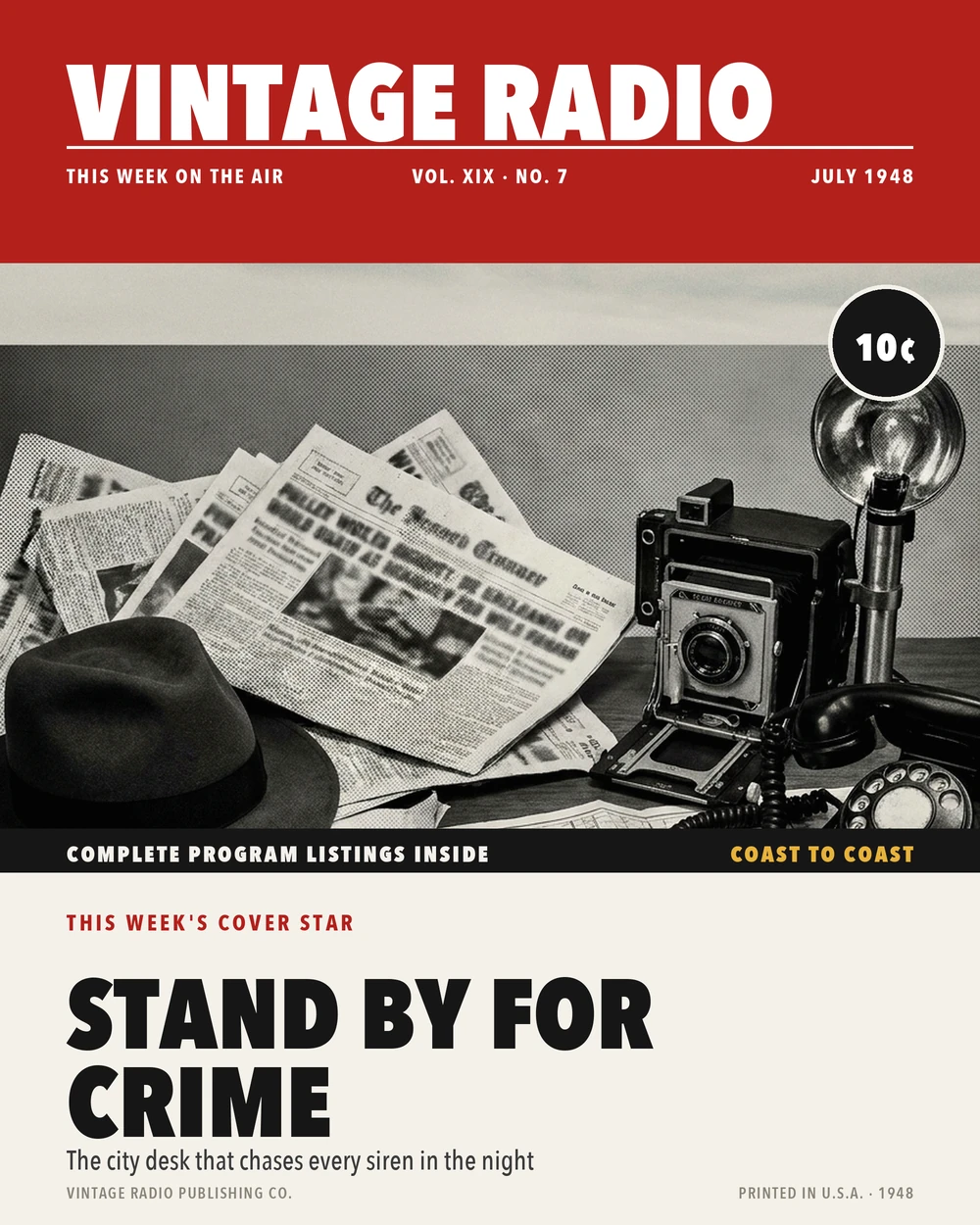
Stand by for Crime
A Reporter, a Police Contact, and a City Full of Crime
What made Stand by for Crime tick was a setup that felt pulled straight from the LA streets in 1953: Chuck Morgan, a news anchor at radio station KOP in Los Angeles, gets tips on hot crimes from his police contact, Lieutenant Bill Miggs, and then wades into the thick of them himself. Chuck wasn't an antihero or a hard-edged private eye working around the law — he was a credible, straight-laced newsman, believable in the way a good reporter is believable. The crimes were real, the tone was clipped and matter-of-fact, and the whole thing moved with the efficiency of a good news broadcast.
The series was a syndicated production, released in 1953 by Bob Reichenbach, and ran to 26 episodes in its U.S. broadcast run. It borrowed its tone from the semi-documentary style that Dragnet and Gangbusters had popularized — crime drama presented without melodrama, the facts laid out plainly and the action keeping pace. That approach wasn't coincidence; it was the sound that audiences trusted in the early 1950s, and Stand by for Crime leaned into it.
The plots themselves were squarely of their moment. Episode titles like "Subversive Activities," "A Spy Ring in June," and "The Communist Menace" reflected the anxieties sitting on every American's doorstep in 1953. Others — "The Sniper," "Death on the Tracks," "Hollywood Love Triangle," "Lonely Hearts Club of Doom" — landed in the more familiar territory of organized crime, murder, and the darker corners of postwar Los Angeles. The writing was noted for sharp dialogue and plot twists that kept the pacing tight from scene to scene.
The Cast Behind the Microphone
Playing Chuck Morgan was Glenn Langan, a Denver-born actor who had come up through stage work before landing a 20th Century-Fox contract in the 1940s. He had screen credits in Dragonwyck (1946), Margie (1946), and The Snake Pit (1948) before the radio series, and would later pick up cult recognition for The Amazing Colossal Man (1957). On the show, his delivery brought exactly the kind of grounded authority the semi-documentary format needed — he sounded like someone you'd actually hear reading the news.
Chuck's "Gal Friday," Carol Curtis, was played by Adele Jergens, billed at times as Adele Jurgens. Jergens had a background as striking as the character she played: born in Brooklyn in 1917, she had been named "Miss World's Fairest" at the 1939 New York World's Fair, worked as a Rockette, and then signed with Columbia Pictures in 1944. On the show, Chuck called her "glamour puss" — a detail that said something about the easy chemistry between the two leads.
That chemistry wasn't performed. Langan and Jergens were husband and wife in real life, having married in 1949 after meeting on the set of the Lippert Productions film Treasure of Monte Cristo. Their off-air familiarity translated into something that felt natural on the air, and it gave the Morgan-Curtis dynamic a looseness that the show's more procedural elements might otherwise have lacked.
The Australian Chapter
The American run of 26 episodes wrapped up to what was considered, commercially, a failure. But the story didn't end there. According to a source preserved from OTR researcher Reg James, the full production run actually totaled 52 episodes: the original 26 U.S. episodes plus an additional 26 recorded in Australia with a local cast after the U.S. market didn't sustain the show. The Australian distribution was handled as part of a four-producer syndicate that included Grace Gibson, a distributor who reportedly transported the first 26 episodes on 16-inch discs to Australia herself — and was later fined for illegally importing them. The 26 Australian episodes remain largely outside the mainstream OTR catalog, and only the U.S. run has been widely documented and collected.
The U.S. series was certified as "Certified Accurate" on April 5, 2006 — a mark that reflects careful verification of the episode set against known broadcast documentation. That certification applies to the 26-episode U.S. run on a single CD.
A Note on the Name
There is a separate, unrelated production that shares the title: an ABC television police drama that aired from January 11 to August 27, 1949, originating from station WENR in Chicago and starring Myron Wallace — later known as Mike Wallace. That television show predates the radio series entirely and has no connection to it. The two have been confused in some references, likely because the TV program's 1949 run sits close to where the radio series is sometimes — incorrectly — placed. The radio series starring Langan and Jergens is a 1953 production, full stop.
What the Show Sounded Like
The production used sound effects and music scores the way the best early-1950s crime radio did — not as decoration, but as tools for building tension and marking transitions. The semi-documentary style meant that the sound design worked in service of mood rather than spectacle: footsteps, phone calls, the ambient noise of a newsroom or a rain-wet street. The effect was close to the tone of a well-produced news feature, which suited the conceit of a reporter-protagonist. The sharp dialogue and constructed plot twists gave writers room to play, but the production kept things grounded. The 26 surviving U.S. episodes carry 1953 air dates confirmed by episode listings, and they hold up as a compact, consistent body of work from the mature years of American radio crime drama.